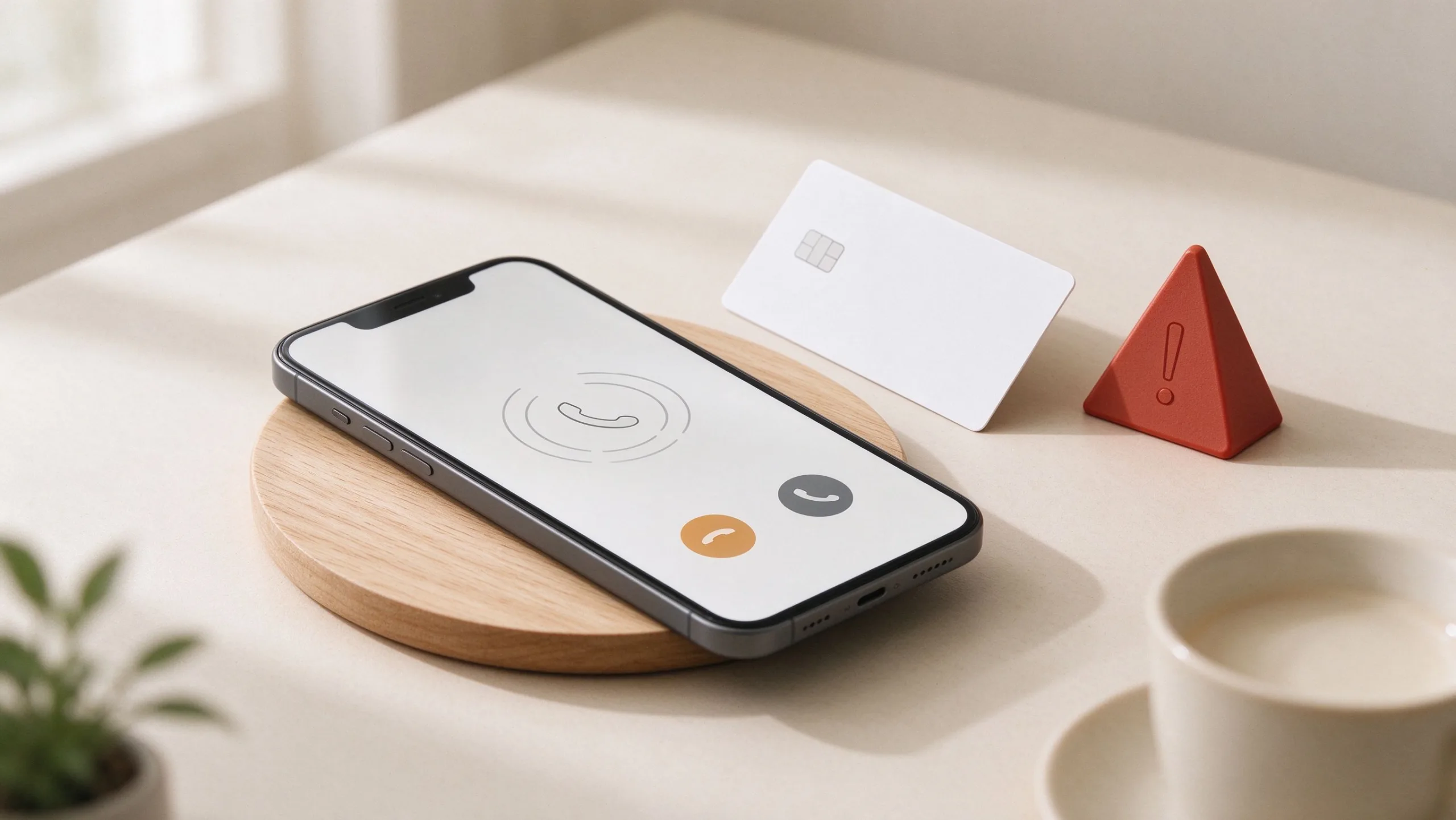
The phone rings. The voice on the other end knows the last four digits of an account or the name of a recent merchant. They say a transfer is about to go out, or a card has been used in another state, or the account will be frozen unless you confirm a code right now.
Your stomach drops. That is normal. What happens next determines whether the moment stays a scare or becomes a real problem.

Do this now
Hang up.
Do not press any buttons. Do not confirm any numbers. Do not stay on the line to “verify” anything. End the call.Write down what you remember.
On paper or in a notes app that is not tied to the phone that just rang, jot the approximate time, the number that appeared on the screen if you saw it, and the exact phrases the caller used. “Transfer to another state,” “security code,” “account will be locked in ten minutes.” Those details matter later.Find the real customer-service number yourself.
Open the official banking app, or look at the back of a physical card, or pull up the bank’s website on a different device. Do not use any number the caller gave you. Do not search only the bank name plus “phone number” in a hurry; phishing sites sometimes rank high. Prefer the number printed on the card or listed inside the official app.Call the real number and explain what just happened.
Tell the representative you received a call claiming to be from the bank. Give the time and the details you wrote down. Ask them to review recent activity and confirm whether any transfer or card use is pending. If nothing is wrong, ask them to note the call on the account. If something is wrong, follow their recovery steps and request written confirmation of any temporary holds or new cards.If the call involved a parent or spouse, stay with them through the callback.
People who have just been frightened often want to call the number on their screen again. Sit with them while they dial the real number. Keep the tone steady. The goal is verification, not a debate about whether the original call “sounded real.”
Why the order matters more than speed
Hanging up first removes the attacker from the conversation. Writing the details next captures information that fades quickly under stress. Locating the official number yourself closes the most common social-engineering path. Only then does the verification call begin. Reversing any of those steps increases the chance that urgency wins and information or access is given away before the real bank is ever reached.
What “do not press any buttons” actually prevents
Some scam calls use automated prompts that capture keypad input or keep the line open so a later “representative” can continue the script. Ending the call cleanly is the simplest way to break that chain. If the phone rings again immediately, let it go to voicemail and proceed with the official number you located yourself. Returning the call to the number that just rang is almost never the safe next move.
Handling the moment when the caller already knows partial details
Attackers often obtain last-four digits or recent merchant names from prior breaches or phishing. Hearing accurate information does not prove the call is legitimate. It only proves that some data was available. The verification path remains the same: hang up and call a number you located yourself. Accuracy of partial details is a common feature of modern scam scripts, not evidence of authenticity, and treating it as proof is exactly the reaction the script is designed to produce.
Why hanging up is the safest first move
Legitimate banks and credit unions do not demand immediate action over an unexpected inbound call. They do not ask for one-time codes that were just texted to you. They do not threaten to freeze an account in the next few minutes unless you stay on the line. When a caller creates urgency and asks you to move money or share a code, the safest assumption is that the call is not from the bank.
Hanging up does not mean the problem is solved. It simply stops the conversation before any information or access is given away. The verification call you place yourself is the step that actually checks the account.
What to document and why it helps
Save three things if they exist:
The phone number that appeared on the caller ID (even if it looked familiar).
Any text or email that arrived around the same time claiming to be from the bank.
A short written summary of what the caller asked for.
These details are useful if you later need to file a report with the bank’s fraud team, the FTC, or a state attorney general’s consumer-protection office. They are also useful if the same number contacts another family member.
Do not forward the suspicious text to other people as a warning. That can accidentally spread the link or number. Describe the pattern instead.
A short script for helping a parent or spouse
If you are the person who gets the “I just got a call from the bank” message, try this:
“I’m glad you called me. Let’s hang up if you’re still on the line. We’ll find the real number on the card or in the app and call them ourselves. I’ll stay on the phone with you while we do it.”
If they are worried they already said too much:
“We can sort that out with the real bank line. The important part is that we stop talking to the first caller and verify everything from our side.”
Avoid the phrases that make people defensive—“You should have known” or “That was obviously a scam.” The person who answered the phone is already stressed. Your job in the first five minutes is to move them to the verified channel.

After the first five minutes
Once the real bank has confirmed the account status, take two more quiet steps.
Check the email address and phone number listed on the account. If either has been changed recently without your knowledge, ask the bank to restore the correct contact information and to add any available extra verification for future changes.
Look at the other accounts that share the same email or phone number. A bank call is sometimes the visible tip of a wider attempt. The Household Account Map guides cover how to review those connections without creating a new mess.
If money actually moved, follow the bank’s formal dispute process and keep copies of every reference number. Time limits for reporting unauthorized transfers can be short; the bank will tell you the exact window that applies to your account type.
What this does not mean
Receiving a suspicious call does not mean every account is compromised. It does not mean you need to freeze credit files in the next hour or buy an identity-monitoring subscription on the spot. It means one channel was used to create urgency. The response is to cut that channel off and verify through a channel you control.
Most families who follow the hang-up-and-call-back sequence end the day with nothing more than a noted incident on the account and a slightly higher awareness of how these calls sound.
The next safe step
Right now, open the banking app or turn over the physical card and save the official customer-service number in your contacts under the bank’s real name. Do the same for any other financial institution the household uses. When the next unexpected call arrives, the verified number is already one tap away.
Take the next safe step.