Many parents begin with rules: no phones in bedrooms, limits on social apps, consequences for late-night use. Those rules matter. They work better when the device itself is already configured to reduce the most common problems—unwanted purchases, location sharing that is broader than intended, and accounts that can be easily taken over.
The settings conversation is quieter and often more effective than the rules conversation. It treats the teenager as a partner in making the phone safer rather than only a recipient of restrictions.
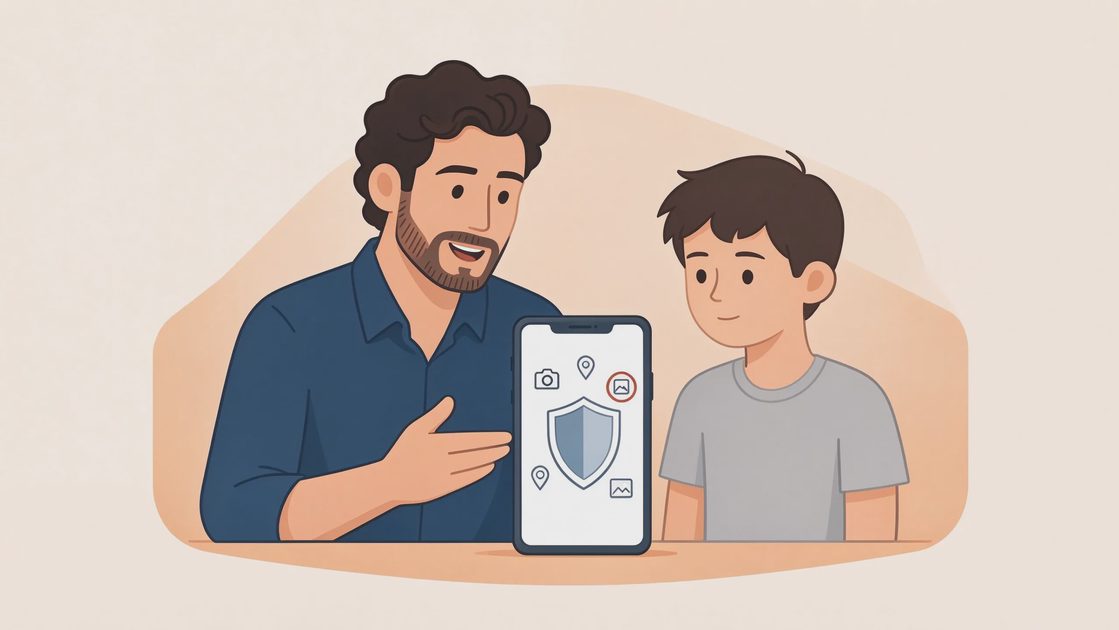
Frame the conversation as shared problem-solving
Start with a calm statement:
“Before we talk about rules, I want us to set the phone so that a lost device or a bad link doesn’t turn into a bigger problem. I’ll show you the settings and you can tell me what feels reasonable.”
This approach reduces defensiveness.
Partnership language versus authority language
Opening with shared problem-solving signals that the teenager’s input matters and that the goal is practical risk reduction rather than control for its own sake. Authority-first openings often produce resistance before any setting is changed. The framing itself is part of the protective design.
Separating settings from rules in time and tone
Discussing settings in a separate, calmer conversation prevents the technical work from becoming entangled with negotiations about screen time or social media. Once the device is configured, the later rules conversation can focus on behavior and expectations without also having to resolve technical questions.
Inviting the teenager’s judgment on reasonableness
Asking what feels reasonable gives the teenager a real role and often surfaces practical constraints the parent had not considered. Settings the teenager helped choose are more likely to remain enabled than settings imposed without discussion.

High-value settings to cover together
1. Screen lock and biometrics
A strong passcode plus Face ID or fingerprint. Confirm the teenager can unlock the phone and that you both know the passcode is not shared with friends.
2. Find My or the Android equivalent
Turn it on. Show the teenager that the device can be located or marked lost. Explain this is for recovery, not for constant tracking of their location by parents.
3. Purchase and download controls
Require authentication for purchases. Review which payment methods are attached. Decide together whether new apps need approval.
4. Two-factor authentication on the main accounts
Email, Apple ID or Google account, and any major social or gaming accounts the teenager uses. Use an authenticator app or the built-in options rather than SMS when possible.
5. Location sharing boundaries
Review which apps have location access and whether it is “while using” or “always.” Decide which family location-sharing features are on and why.
6. Private browsing and account logins on shared devices
If the teenager uses family computers or tablets, agree on signing out of personal accounts when finished.
Screen lock as the first and most visible protection
A strong passcode and biometrics protect the device if it is left unlocked or taken. Confirming that the teenager can operate both methods and that the passcode is not casually shared with friends closes two common gaps. The conversation also surfaces whether the current passcode is weak or widely known.
Find My framed as recovery rather than surveillance
Teenagers often resist features they interpret as parental tracking. Explicitly stating that Find My exists so a lost or stolen phone can be locked or located, and demonstrating the recovery functions, reframes the setting as protective rather than intrusive. Many teenagers accept the feature once the recovery purpose is clear.
Purchase controls as protection against both mistakes and pressure
Requiring authentication for purchases prevents accidental or pressured spending when a friend borrows the phone or when an in-app prompt appears. Reviewing attached payment methods and deciding together whether new apps need approval turns a potential conflict into a negotiated boundary the teenager has helped set.
What to leave for the rules conversation
Screen-time limits, social-media expectations, and consequences for broken agreements belong in a separate discussion. Mixing them with settings often turns a technical conversation into a power struggle.
Keeping the settings session technically focused
When screen-time rules or social-media content expectations enter the settings conversation, the teenager’s attention shifts from the technical changes to the behavioral negotiation. Completing the settings first produces a more secure device; the behavioral conversation can then proceed on its own terms.
Avoiding the overloaded single conversation
A single long discussion that tries to resolve device configuration, daily time limits, and content rules usually ends with fatigue and incomplete agreements. Separating the conversations by time and topic increases the chance that each produces clear, usable outcomes.
Using the completed settings as a foundation for later rules
Once the device already requires authentication for purchases and has Find My enabled, the rules conversation can focus on behavior without also having to invent technical safeguards. The settings become the quiet infrastructure that makes the rules more effective.
Involving the teenager in the “why”
Explain the purpose of each setting in plain language:
“The purchase lock means a friend can’t buy something on your phone if you hand it over for a minute.”
“Find My is so we can lock it if it’s left on a bus. It’s not about watching where you go every day.”
When teenagers understand the concrete risk being reduced, they are more likely to leave the setting on.
Concrete scenarios instead of abstract security
Teenagers respond more readily to specific, plausible situations than to general warnings about “security.” Describing a friend borrowing the phone or a phone left on a bus makes the purpose of the setting immediate and personal. Abstract risk language often lands as parental anxiety rather than practical protection.
Distinguishing recovery from monitoring
Location and Find My features are frequently interpreted as surveillance. Naming the recovery purpose explicitly, and stating what the feature is not for, reduces that interpretation. Clarity about intent is as important as the technical configuration.
Linking settings to the teenager’s own goals
Many teenagers value not losing a phone, not being responsible for unexpected charges, and not having accounts taken over. Connecting each setting to one of those goals makes the configuration feel aligned with the teenager’s interests rather than imposed against them.
Documenting the setup
Note the main account emails and that two-factor is enabled on the household account map. Store any backup codes with the emergency sheet. Both parent and teenager should know where recovery information lives.
Shared knowledge of recovery materials
Backup codes and recovery contacts are useful only if the people who may need them can find them. Recording their location on the household map and emergency sheet, and ensuring the teenager knows the location exists, completes the protective design.
Avoiding secret configurations
Settings that only the parent understands or can reverse create a system the teenager cannot maintain or recover. Documenting the main accounts and the fact that two-factor is enabled keeps the configuration transparent and recoverable by both parties.
Updating after account or device changes
A new phone, a new primary email, or a new major social or gaming account is a natural moment to update the documentation. Treating the record as living rather than one-time keeps the recovery paths accurate.
What this does not mean
Strong settings do not replace ongoing conversation or parental judgment. They simply reduce the number of problems that require emergency intervention.
Settings as infrastructure, not complete solution
A well-configured phone still requires ongoing conversation about judgment, peer pressure, and content. The settings reduce the frequency and severity of certain technical failures; they do not eliminate the need for relationship and guidance.
Judgment remains necessary
No set of toggles can anticipate every social or emotional situation a teenager will encounter. Parental judgment, expressed through continued conversation rather than only through device controls, remains essential. The settings make that judgment more effective by removing some of the purely technical failure modes.
The conversation itself is part of the protection
Treating the teenager as a partner in the settings discussion builds the habit of talking about risk and protection. That habit is itself a form of safety that outlasts any particular configuration of toggles.
The next safe step
Sit with the teenager and review only the screen lock and Find My settings together. Confirm both are on and that the teenager can demonstrate unlocking and locating the device. That small shared success builds the foundation for the rest.
Take the next safe step.